FIH World Rankings: how 2025 shook things up

FIH World Rankings: how 2025 shook things up

23 Dec, 2025 International hockey in 2025 delivered a relentless calendar of top-flight action — from the FIH Hockey Pro League battles to Nations Cup and Nations Cup 2 drama along with Continental Championships across all continents — sparking notable shifts in the FIH World Rankings. Across both the men’s and women’s game, familiar powers consolidated their positions while emerging teams made meaningful gains. In the women’s rankings, Netherlands (3809) who started the year in the top spot, maintained their stranglehold throughout the year, with another stellar season where they added more trophies to their cabinet with championship runs at the Pro League and the EuroHockey Championships, while Argentina (3326), Belgium (3109) and China (2977) with great continental championship and Pro League campaigns continue in the second, third and fourth places respectively, where they started the year. Spain (2777) are amongst the biggest gainers of the year among the top-10 rankings, as they find themselves in the fifth spot, having started the year in eighth! Spain’s climb comes at the expense of Australia (2758), Germany (2734) and England (2510) who have all dropped one place from where they started the year, ending it in sixth, seventh and eighth spots. New Zealand (2319) who won the Women’s FIH Hockey Nations Cup and the Oceania Cup in 2025 have climbed to ninth place above India (2315), who suffered Pro League relegation in 2025. Japan (2186) and United States (2172) are up two places into eleventh and twelfth at the expense of Ireland (2030) and Chile (1999) who are down to thirteenth and fifteenth, with Scotland (2015) in fourteenth. Korea (1864) remain in sixteenth, followed by France (1742) whose triumph at the FIH Hockey Nations Cup 2 saw them climb three spots up. Italy (1737), Uruguay (1736) and South Africa (1670) round out the top-20, with Canada (1668) and Malaysia (1667) just outside! In the men’s rankings, Netherlands (3376) and Belgium (3225) continue to hold the top two spots, but there are plenty of shake-ups below compared to the start of the year! Germany (3116) are up one spot into third following a successful EuroHockey campaign, followed by Argentina (3022) who are up to fourth after starting the year in eighth spot! Australia (3007) and Spain (2995) are up one spot each in fifth and sixth, followed by England (2864) and India (2845) who suffered the biggest drops, having started the year in third and fifth spots respectively. France (2371) remain in the ninth, while New Zealand (2254) and Ireland (2246) have swapped places with each other since the start of the year. South Africa (2127) and Malaysia (2097) remain steady in twelfth and thirteenth. Following their promotion to the FIH Hockey Pro League, Pakistan (2034) are up one place in fourteenth, followed by Wales (1989) and Korea (1981). Egypt (1956) who had a stellar debut at the FIH Hockey Nations Cup 2, are big movers for the year, finding themselves in seventeenth. Japan (1982), Canada (1863) and Scotland (1843) round out the top-20, with Austria (1805), Chile (1727), China (1723), Poland (1694) and United States (1690) occupying the next five spots. To see the complete FIH World Rankings including Indoor and Junior World Rankings, please click here. The rankings calculations model that FIH introduced on 1st January 2020 moved away from the previous tournament-based rankings system to a dynamic, match-based method where opposing teams exchange points in official, FIH sanctioned games. The number of points exchanged depends on the result of the match, the relative ranking of the teams and the importance of the match. More information about the new rankings model can be found below. How the FIH World Rankings work: The number of points exchanged depends on the result of the match, the relative ranking of the teams and the importance of the match. FIH World Rankings explained: Based on the Elo rating system, which is used as the basis of many other sports ranking systems When two nations play against each other, a number of ranking points are exchanged between them In every match, the number of points gained by one team is exactly matched by the number of points lost by the other Teams will win more points for beating teams ranked above them, and therefore teams will lose more points for losing to a team ranked below them Teams will win less points for beating teams ranked below them, and therefore teams will lose less points for losing to a team ranked above them If a draw occurs, the lower ranked team will gain a small number of points and the higher ranked team will lose the same number of points The number of points exchanged is dependent on the result of the match (win, lose, shootout win/loss or draw), the importance of the match (part of a major tournament, or a test series for example), and the relative difference in ranking points between the teams before the match. More details about the formula used in the algorithm, weightings of matches and other factors can be found HERE together with a Frequently Asked Questions document HERE. Source: FIH.hockey

FIH signs Joint Sport Pledge for Inclusion and Protection of Refugees

FIH signs Joint Sport Pledge for Inclusion and Protection of Refugees

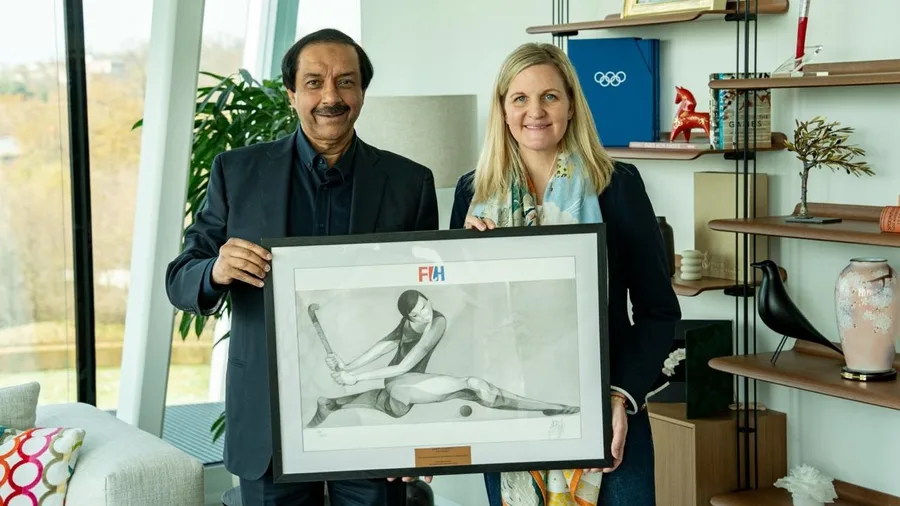
18 Dec, 2025 The International Hockey Federation (FIH) has joined the Global Refugee Forum Multi-stakeholder Pledge on Sport for Inclusion and Protection by becoming a signatory today, coinciding with Honorary IOC President Thomas Bach, who chairs IOC Olympic Refuge Foundation, addressing the delegates of the Global Refugee Forum Progress Review 2025 currently being held in Geneva, Switzerland. The Global Refugee Forum (GRF) is the world’s largest international gathering in support of refugees and the communities that host them. The GRF Progress Review marks the mid-point in the GRF cycle and aims to track implementation of pledges made at the previous forum. The Multi-stakeholder Sport Pledge outlines the role that sport can play in improving the lives of refugees, including through sport programming, policy change, skill development, and communication and advocacy efforts. As a signatory, FIH has committed to: Under the banner of the Hockey Foundation and with the support of the FIH Academy, offer relevant resources and skills development/training opportunities to ensure the global hockey community is supported to promote the inclusion of displaced people in hockey activities and in hockey communities hosting refugees Under the banner of the Hockey Foundation and with the support of the FIH Academy, implement initiatives to identify and grow coaching expertise within displacement affected communities, supporting refugee coaches to deliver regular sustainable hockey activities Promote, through its communications, the powerful role of sport as part of a whole of society response to address the challenges of the global displacement crisis Provide brief updates of its activities in support of the pledge to the Sport for Refugees Coalition/Global Refugee Forum team Thomas Bach, IOC Honorary President and Chair of the Olympic Refuge Foundation, said: “We are delighted to have the International Hockey Federation joining the Sport for Refugees Coalition. International Federations play a crucial role in leading their sport forward in the protection of displaced people. Through this initiative, the FIH will ensure the global hockey community is equipped to promote the inclusion of displaced people worldwide. We welcome the FIH to our Coalition and hope that their example will inspire other actors across the Olympic Movement to join us.” FIH President Tayyab Ikram said: “FIH is committed to building a better world through sport and to supporting development, increasing participation and improving accessibility of hockey worldwide. Today, I feel very proud to lead an organisation that has added another milestone to this bold commitment by becoming a signatory to the Joint Sport Pledge for Inclusion and Protection. I would like to commend the exceptional work done by the Olympic Refuge Foundation, and especially its Chairman, Honorary IOC President Thomas Bach.” FIH joins more than 170 organisations, including over 40 National Olympic Committees and International Federations, as well as governments, refugee-led organisations, UN agencies, civil society organisations, private sector representatives and beyond in supporting the pledge. FIH has also recently joined as a signatory of the Statement from the Sport for Refugees Coalition which is a group of organizations and other entities focused on supporting displaced people through sport. The Statement advocates for the integration of sport into refugee response efforts. The Sport for Refugees Coalition is co-convened by the Olympic Refuge Foundation, UNHCR, the UN Refugee Agency, and the Scort Foundation. As a new member of the Sport for Refugees Coalition, FIH endorses the joint statement calling for governments, donors, sports bodies, and humanitarian actors to embed sport more fully in refugee responses, ahead of the Global Refugee Forum Progress Review (GRF PR). #MadeForHockey #HockeyForSociety #RefugeeForum #Sport4Refugees For more information about FIH and hockey in general, please download the Watch.Hockey app or follow the FIH social media channels – Facebook, Instagram and Twitter – and website. #MadeForHockey #HWC2026 Source: FIH.hockey

Netherlands seal third consecutive world title at the FIH Hockey Women’s Junior World Cup Santiago 2025 after defeating Argentina in the final

Netherlands seal third consecutive world title at the FIH Hockey Women’s Junior World Cup Santiago 2025 after defeating Argentina in the final

14 Dec, 2025 The final day of the FIH Hockey Women’s Junior World Cup City of Santiago 2025 was defined by the Netherlands’ crowning moment, as they defeated Argentina 2-1 in the final to reaffirm their historical dominance in the category. The Dutch side reached a record sixth world title and completed a third consecutive crown following their triumphs in 2022, 2023 and now 2025. The Netherlands settled the match in the first half with a goal from a penalty corner and another from open play, then protected their narrow lead in the decisive stages through a very compact defensive structure that withstood sustained Argentine pressure on the turf of the Estadio Nacional. The conclusion of the tournament also saw Belgium secure the bronze medal, following a convincing 5-1 victory over China in the third-place play-off. Their campaign was marked by consistency, including a single defeat via shoot-out in the semi-finals and a group-stage draw against Argentina. In the classification matches, Austria finished in 21st position with a 3-1 win over Malaysia, while Zimbabwe closed their participation with a narrow 2-1 victory against Namibia in the play-off for 23rd and 24th places. Below is the full breakdown of all matches on Day 13 in Santiago. Namibia vs Zimbabwe (Full-Time Score: 1-2) Namibia opened the final day of the tournament with a well-structured high press and early volume of circle penetrations, maintaining the initiative through Q1 and Q2. After an early penalty corner, Maryke Kruger opened the scoring for a 1-0 lead, before Zimbabwe levelled midway through the first quarter with Nyasha Bvute finishing a transition move inside the circle. The second quarter followed a similar territorial pattern, with Namibia continuing to enter the circle and generate set-piece opportunities, but without the efficiency needed to extend their advantage. After the break, Zimbabwe adjusted their controlled build-up and gained greater presence in the attacking half, reducing Namibia’s influence inside the circle. In Q3, the African side earned a penalty stroke that they were unable to convert, but they sustained their pressure and eventually found the decisive moment later in the quarter, when Panaka Kambadza scored to make it 2-1. In the closing stages, Namibia pushed forward with attacking rhythm and looked for the equaliser from penalty corners, while Zimbabwe closed the match with a compact block, protected their 23m area and defended with discipline to secure the win in the play-off for 23rd and 24th place. Zimbabwe captain Tinodiwanashe Elijah, who was named Player of the Match, said, “I’m proud of my team-mates for keeping going and keeping pushing. It’s been a hard tournament; we deserved this one and we will keep working for it. I’m really proud of everyone. Thank you so much, thank you.” Austria vs Malaysia (Full-Time Score: 3-1) Austria settled quickly into the match and struck first with an open-play goal by Anna Damm in the 12th minute, during a phase in which they established themselves with composure in the attacking half and began to dictate tempo around the circle. Malaysia remained organised, absorbed the early setback and responded with more stable possession and a balanced first half, in which they even generated a higher volume of circle penetrations. That reaction was rewarded before the break when Mohd Nur equalised in the 27th minute, also from open play, for a 1-1 scoreline that reflected a more even contest than the opening moments suggested. After half-time, Austria turned their sustained pressure into a decisive advantage by increasing their circle entries and earning multiple penalty corners. The breakthrough came in the third quarter, when Katharina Proksch converted from the set piece in the 33rd minute. Malaysia attempted to stay in contention and earned five penalty corners across the match, but lacked the efficiency to reduce the deficit. In the final quarter, Austria struck again from a penalty corner through Proksch in the 49th minute and managed the closing phases with territorial control and game management to secure the 3-1 victory, finishing 21st in the tournament, while Malaysia concluded their campaign in 22nd place. Austria’s Katharina Bauer was named Player of the Match and told the official watch.hockey broadcast, “I think the beginning was quite positive for us and it’s nice to finish the tournament with a win. It was a great tournament and a great experience for the team.” Belgium vs China (Full-Time Score: 5-1) Belgium took control early and opened the scoring in the 14th minute through Louise Dewaet, closing the first quarter 1-0 after a strong pressing start and increased attacking traffic inside the circle. China responded with longer spells of possession in Q2 and managed to balance the territorial rhythm, though without consistent penetration in the final third. The second quarter passed without goals, as both teams alternated controlled build-up play and organised defensive structures on the turf, with set pieces appearing intermittently but without impact on the score before the interval. The turning point arrived in the third quarter, when Belgium raised their attacking intensity and converted territorial dominance into a four-goal burst. Agathe Favart doubled the lead in the 30th minute, Alexi Van Remortel followed two minutes later, Dewaet added her second in the 43rd minute, and Louise Van Hecke completed the sequence in the 44th, producing a decisive spell of pace and efficiency. China continued to press from penalty corners and pulled one back in the 51st minute through Zuo Dandan, but Belgium controlled the closing stages with a compact structure and composed time management. The result secured Belgium third place in the Junior World Cup, following a campaign that included only a shoot-out defeat in the semi-finals and a group-stage draw against Argentina, and also featured a record number of goals scored in a single match during the opening phase. Belgium’s Louise Dewaet, named Player of the Match, said, “It was not our best game, but we still put 5-1 on the board. I’m really proud and happy that we won the bronze medal today. Thank you.” Netherlands vs Argentina (Full-Time Score:

Continue Reading →

Scotland lift the Challenger Trophy on the eve of the Final at the FIH Hockey Women’s Junior World Cup in Santiago

Scotland lift the Challenger Trophy on the eve of the Final at the FIH Hockey Women’s Junior World Cup in Santiago

13 Dec, 2025 Scotland were the standout team of the day as they claimed the FIH Hockey Women’s Junior World Cup Challenger Trophy, overcoming hosts Chile in the shoot-out after a 1-1 draw in regular time. The British side thus became the first-ever winners of the trophy, introduced on the initiative of FIH President Tayyab Ikram as a sign of encouragement and recognition for the teams competing in the classification matches from 17th to 24th place at the tournament. The day also confirmed key final positions at the Junior World Cup, with Australia defeating England to finish seventh, Germany securing fifth place against the United States, and New Zealand closing their campaign with a victory over Canada. The tournament now moves into its decisive chapter, with Saturday’s final between Argentina and the Netherlands set to take place at 19.15 at the Centro Deportivo de Hockey Césped within the Estadio Nacional. Below is the full breakdown of all matches on Day 12 in Santiago. England vs Australia (Full-Time Score: 2-3) Australia set the early tone on the synthetic surface of the Estadio Nacional in Santiago de Chile, enjoying greater possession and applying high pressure in the opening quarter. England responded with defensive organisation and a compact mid-block, absorbing the initial momentum and successfully defending three penalty corners in Q1. The scoreline remained tight until the second quarter, when Jessica Dyson opened the scoring in the 28th minute following a move inside the circle. Australia maintained their collective structure but reached the break trailing by the narrowest of margins despite sustained attacking traffic and multiple circle penetrations. After the restart, the match shifted in tempo. Australia adjusted their press and found greater width, levelling the score in the 37th minute through Mihaylia Howell and taking the lead two minutes later, once again via Howell. Samantha Love extended the advantage in the 41st minute, capitalising on Australia’s territorial dominance during the third quarter. England pulled one back a minute later through Hannah Boss and pushed late on, defending and attacking in transition, but Australia managed the closing stages with a compact structure, resisted the final attempts and closed out the match with defensive control to secure seventh place in the tournament, while England finished eighth. Australia’s Makayla Jones, named Player of the Match, expressed, “I think we did really well from the start of the year in building strong foundations as a group. It might not be the position we wanted to finish in, but it was important to get the win in the end. We created a number of attacking opportunities and, from back to front, we worked really well together and converted when it mattered, which is why we got the result.” United States vs Germany (Full-Time Score: 1-3) Germany took territorial control from the outset on the second matchday in Santiago. They dominated the circle with a higher volume of penetrations and found their first breakthrough before the interval. After a scoreless opening quarter, the German side sustained their pressure and opened the scoring in the 26th minute through Lena Frerichs, following a sequence that ended with a composed finish inside the circle. The United States adopted a deeper defensive block and went into the break without scoring and with limited attacking presence in the opposition 23 metres. After the interval, Germany extended their lead with a strong spell in the third quarter. Lynn Krings struck in the 32nd minute and Katharina Haid added a third four minutes later, consolidating Germany’s control in both tempo and depth. Frerichs had the opportunity to further extend the lead from the penalty stroke in the 44th minute but was unable to convert. The United States pulled one back late on through Daniela Mendez-Trendler in the 50th minute, attempting to build momentum in transition, but Germany managed the closing phase with a compact structure and maintained the margin to secure a deserved fifth-place finish at the Junior World Cup. The Americans concluded the tournament in sixth place. Germany’s Martina Reisenegger reflected on the team’s performance at the end of the match and expressed, “We are very happy to have closed the tournament with this performance. We aimed for more, but Argentina were a very strong opponent in the quarter-finals. We trained a lot throughout the year and we are proud of what we achieved and satisfied with fifth place.” New Zealand vs Canada (Full-Time Score: 2-0) New Zealand set the tone early in the third match of the penultimate day of the Junior World Cup in Santiago, applying high pressure and asserting territorial control in the opening quarter. The Oceania side opened the scoring inside the first minute, with Niamh McKenzie finishing after an entry into the circle, and maintained control through patient circulation and repeated penetrations. Canada responded with a low defensive block, successfully defending two penalty corners in the first half, but struggled to generate attacking clarity against a well-organised defence. After the break, New Zealand continued to dictate proceedings, managing possession and once again establishing play in the attacking half, accumulating circle entries and sustaining pressure in the final metres. Canada remained organised defensively and looked to break in transition during the closing stages, limiting space and keeping the contest alive until the final moments. The second goal arrived late, in the 59th minute, through Greer Findlay, completing a sustained press and sealing the result. With the win, New Zealand finished 19th overall, while Canada concluded the tournament in 20th position. Player of the Match Niamh McKenzie stated during the official Watch.Hockey broadcast, “The coaches asked for a complete performance and I think we delivered that today. It’s been a long couple of weeks with ups and downs, and to finish the tournament this way is really special. I’m very grateful for the experience and proud of the team.” Scotland vs Chile (Full-Time Score: 1-1, SO: 4-3) Chile took the initiative from the opening whistle in front of their home crowd, backed by a strong turnout of supporters with the

Continue Reading →

Shootout Thrillers, Historic Milestones, and Clinical Dutch Finishing Headline Four-Game Slate

Shootout Thrillers, Historic Milestones, and Clinical Dutch Finishing Headline Four-Game Slate

12 Dec, 2025 It was a dramatic day of FIH Pro League action across Dublin and Santiago del Estero, with late goals, breakthrough performances and dominant displays shaping four compelling fixtures. England and Belgium traded momentum in a thrilling men’s draw before the English secured the bonus point in the shootout, while Ireland earned their first-ever Pro League points after a gritty 1–1 battle with England’s women. In Argentina, both national sides impressed on home turf. The Leonas fell to a clinical Dutch outfit in a rain-shortened 4–0 defeat, but the Argentine men delivered a sharp and composed performance to edge Pakistan 3–2 in one of the day’s most entertaining contests. (Men’s) Belgium 2 – 2 England (SO: 2 – 3) Having relinquished their early lead, England came from behind with 30 seconds left on the clock to pull off a 2-2 draw with Belgium and then take the extra point in the shootout. It was all Belgium in the opening phases of the game as the Red Lions enjoyed much of the possession and piled on the pressure, forcing a great early save from James Mazarelo. The English found their feet, however, and they were first to strike when Henry Croft hammered it in from the top of the circle off the first penalty corner of the match. While the Belgians showed plenty of patience in their build-up, the England defence made it difficult to create any real chances in the second quarter. All the action came at the other end, where a determined England were awarded four penalty corners on the trot. But the Belgians managed to prevent any further goals, with Maxime van Oost pulling off a particularly impressive diving save off the line to keep it 0-1 at half-time. Belgium created far more opportunities in the third quarter, but the English defence again held firm. The breakthrough finally came at the start of the fourth, with Arno Van Dessel deflecting in the equaliser in the 47th minute. The Belgians then snuck in front with a sensational goal six minutes later, as Nelson Onana deflected in from an acute angle. Not to be outdone, the English came up with a scorcher of their own. With just half a minute remaining, Jacob Payton’s first-time reverse strike from a high ball into the circle ensured England rescued the draw and then went on to claim the extra point with a 3-2 win in the resulting shootout. Henry Croft was named player of the match and said: “I feel great. Thanks to the boys for getting us through it… We just said let’s stick together, trust the process, because we’ve done a lot of work, and stay together as a group, and good things happen.” (Women’s) Ireland 1 – 1 England (SO: 4 – 3) Ireland claimed their first ever points in the FIH Hockey Pro League with a courageous 1-1 draw with England, then going on to clinch the shootout 4-3 for the bonus point. The Irish adapted faster to the extremely wet pitch conditions and dominated England in the first half. They won most of the 50/50 battles and ran freely on attack without reward in the opening quarter. They had some close calls in defence in the second, and goalkeeper Elizabeth Murphy had to save a penalty stroke in the 20th minute to keep matters level. English goalkeeper Miriam Pritchard stepped out quickly to shut down Sarah Torrans in the 26th minute, but Ireland’s hard work paid off a couple of seconds later. England turned over possession inside their own 23m area and Mikayla Power’s pass across goal found Torrans who slapped in for a 1-0 lead at half time The third quarter was evenly contested with both teams struggling to penetrate the circle. Elena Rayer equalised for England in the 36th minute from an almost identical play to Ireland’s goal, and the stage was set for a thrilling final quarter. Ireland applied almost continuous pressure at the start of the period. England weathered the storm and enjoyed some attacking of their own, only to be blocked by brave first-wave running from the Irish. There was late drama when the Irish caught England trying to run the ball out of defence with 15 seconds left on the clock, but Jessica McMaster’s snapped shot clattered into the side of the goal and the match went to a shootout. Ireland held their nerve to win that, much to the delight of the home fans. Mikayla Power was named player of the match for Ireland and said: “It feels amazing, second Pro League game, making our debut in Ireland yesterday and then our second game today with a big home crowd, it just means so much, and just so nice to get points on the table.” (Men’s) Argentina 3 – 2 Pakistan Argentina edged Pakistan 3–2 in a lively contest, surviving a spirited fightback to claim full points at home. Pakistan had an excellent start, playing at a high tempo that generated early chances. Waheed Ashraf Rana was the first to truly test the Argentine back line, but Tomas Santiago produced a strong close-range save. Rana came close again moments later, flashing a shot past the far post, while Argentina struggled to convert their own penalty corner opportunities — a Tomas Domene backhand rippling only the outside of the goal. Argentina finally broke through in the second quarter when Domene finished from close range after a sharp baseline sequence from Thomas Habif to Ignacio Nardolillo, who squared the ball perfectly for the finish. The lone goal held through to halftime. The third quarter exploded with action. Pakistan equalized through Muhammad Ammad, who got a clever touch on a Zikriya Hayat pass to make it 1–1. Argentina responded immediately with a superb pair of penalty-corner conversions just one minute apart — Nicolás della Torre firing low into the corner before Maico Casella launched a flick high into the net after a series of re-awards. Pakistan earned their own trio of

Continue Reading →